

insight-ingle-left-2
insight-ingle-left-3

July 9, 2026

Getting Your SOC Report Right the First Time

The RFP looked like a perfect fit. The scope matched your capabilities, the relationship was warm, and your team was ready to move. Then the prospective client’s vendor management team sent over their due diligence requirements, and buried in section three was the line that stopped everything cold: “Please provide your most recent SOC 1 or SOC 2 report.”

You don’t have one. And now a deal that should have been straightforward just got complicated.

This moment is becoming unavoidable. The organizations you want to work with increasingly require service organization control (SOC) reports as a baseline condition for doing business. Not because your organization operates in a heavily regulated environment, but because the clients and partners evaluating you need proof that your operations, data handling, and internal controls meet a verifiable standard.

The instinct when that moment arrives is predictable: find an auditor fast, get the report done, and get back to selling. That instinct is exactly how companies end up with a painful, expensive audit that still doesn’t produce a clean result.

Why the “Just Get It Done” Approach Backfires

Here’s the pattern. A growing service firm hires an auditor, expecting the examination to be a few weeks of gathering documents and answering questions. Midway through fieldwork, the auditor discovers that access controls are inconsistent, the change management process lives in one person’s head, and evidence collection is a patchwork of screenshots and email threads.

The audit stalls. The operations team gets pulled off client work to backfill documentation. Exceptions stack up. The report, if it gets issued at all, comes back with qualifications that make your prospective partner more nervous, not less.

The damage isn’t just a bad report. It’s the two quarters of internal disruption, the stalled pipeline, and the nagging realization that the control gaps the auditor found were real operational risks you’d been carrying without knowing it.

When leadership treats a SOC report as a box to check, the playbook usually looks the same: scramble to document controls that may or may not exist, pull key personnel off their day jobs to gather evidence, and hope the auditor doesn’t find too many gaps.

Here’s what typically happens following this approach:

  • Failed or heavily qualified examinations because controls were described on paper but not implemented or tested.
  • Burned-out teams who spent months in reactive mode, fielding auditor requests they weren’t prepared for.
  • Operational blind spots that persist long after the report is issued, because the goal was passing the exam, not building a genuinely strong control environment.
  • Wasted budget on remediation after the fact, when the same investment upfront could have prevented the issues entirely.

The checkbox approach doesn’t just risk the report. It risks the reputation you’re trying to protect.

Start at the Foundation, Not the Finish Line

The companies that get clean SOC reports on their first attempt don’t have bigger teams or deeper pockets. They start earlier, and they start at the bottom.

Johnson Lambert’s SOC engagement follows a six-phase roadmap built around one principle: by the time you reach your Type 2 examination, there are no surprises. Each phase builds on the one before it, turning what most companies experience as a fire drill into a structured, manageable process.

The two phases that matter most are the ones most companies want to skip.

Phase 1: Gap Assessment & Future-State Design (4–6 Weeks)

Before writing a single policy or configuring a single control, Johnson Lambert evaluates your current environment—processes, systems, documentation—against what a SOC examination actually requires. The output is a Controls for SOC Report and a Gap Assessment that tells you exactly where you stand and what needs to change.

For any size  company, this step is critical. You’ve likely built your operations organically, smart people solving problems in real time. That works until an auditor needs to see documented, repeatable evidence. The gap assessment replaces gut feel with a clear, prioritized action plan sized to your organization.

Phase 2: Institutional-Grade Foundation (8–12 Weeks)

This is where the real work happens and where the business value lives beyond the audit. Phase 2 formalizes your policies, defines standard operating procedures, and strengthens governance so your organization runs on documented processes rather than tribal knowledge.

The deliverables, policies, governance frameworks, and process documentation aren’t just audit artifacts. They’re operational infrastructure. Companies that go through this phase consistently find that their teams onboard new employees faster, resolve incidents with less confusion, and handle client audits with less scrambling. The SOC report becomes a byproduct of a better-run business, not a separate project bolted onto a shaky operation.

Phase 3: SOC Type 1 Report (4-6 Weeks)

This initial report attests that internal controls at your organization are designed effectively and meet applicable criteria at a specific point in time.  The Type 1 report documents applicable controls within the reporting framework.

No Surprises Before the Real Test

Once a Type 1 report confirms your controls are designed correctly, Johnson Lambert doesn’t hand you a report and disappear. Phases 4 and 5, Operational Confidence Testing and the Operational Safety Net, exist to stress-test your controls before the Type 2 examination window opens.

Operational Confidence Testing (8–12 weeks) is a hands-on review that verifies your controls are actually working as designed. The output is a Remediation Tracker, a specific, actionable list of what needs to be tightened. The Operational Safety Net phase (4–8 weeks) gives your team time to close those gaps and strengthen evidence collection.

By the time the Type 2 window begins, your organization has already been through a dry run. The 6–12 month examination period becomes about maintaining what you’ve already built, not scrambling to build it under pressure.

What Changes When You Build It Right

A clean SOC report doesn’t just unlock one contract. It changes how clients and partners evaluate you. Due diligence cycles shorten. Vendor questionnaires get answered in hours instead of weeks. You stop competing on promises and start competing with proof.

That shift is transformative. Your path to a clean report is shorter and more straightforward, but only if you build it on a solid foundation instead of rushing to the finish line.

Map Your Timeline

Every organization’s path looks different depending on size, complexity, and current readiness. The smartest move is to find out where you actually stand before making commitments to prospective partners.
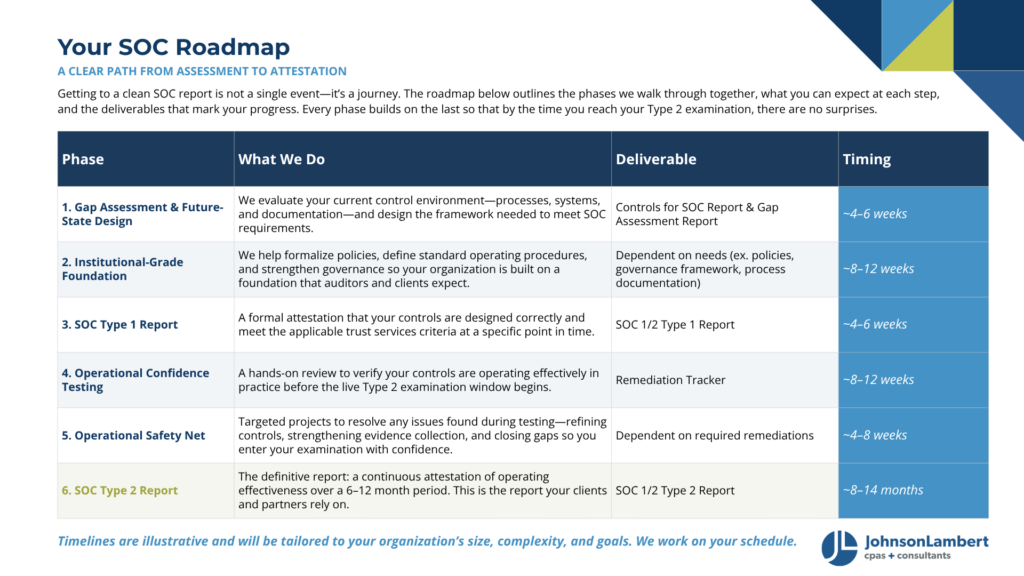
Download Johnson Lambert’s SOC Roadmap to see the full six-phase framework, or schedule a consultation to map out a timeline built around your specific goals.


Kim Mobley

Kim Mobley

Partner

Greg Daniel

Greg Daniel

Managing Director

Carly Kanwisher

Carly Kanwisher

Senior Manager

Questions?

Reach out to our team for a walkthrough of the framework, or schedule a consultation to map out a timeline built around your specific goals.

Contact Us

Getting Your SOC Report Right the First Time

The RFP looked like a perfect fit. The scope matched your capabilities, the relationship was warm, and your team was ready to move. Then the prospective client’s vendor management team sent over their due diligence requirements, and buried in section three was the line that stopped everything cold: “Please provide your most recent SOC 1 or SOC 2 report.”

You don’t have one. And now a deal that should have been straightforward just got complicated.

This moment is becoming unavoidable. The organizations you want to work with increasingly require service organization control (SOC) reports as a baseline condition for doing business. Not because your organization operates in a heavily regulated environment, but because the clients and partners evaluating you need proof that your operations, data handling, and internal controls meet a verifiable standard.

The instinct when that moment arrives is predictable: find an auditor fast, get the report done, and get back to selling. That instinct is exactly how companies end up with a painful, expensive audit that still doesn’t produce a clean result.

Why the “Just Get It Done” Approach Backfires

Here’s the pattern. A growing service firm hires an auditor, expecting the examination to be a few weeks of gathering documents and answering questions. Midway through fieldwork, the auditor discovers that access controls are inconsistent, the change management process lives in one person’s head, and evidence collection is a patchwork of screenshots and email threads.

The audit stalls. The operations team gets pulled off client work to backfill documentation. Exceptions stack up. The report, if it gets issued at all, comes back with qualifications that make your prospective partner more nervous, not less.

The damage isn’t just a bad report. It’s the two quarters of internal disruption, the stalled pipeline, and the nagging realization that the control gaps the auditor found were real operational risks you’d been carrying without knowing it.

When leadership treats a SOC report as a box to check, the playbook usually looks the same: scramble to document controls that may or may not exist, pull key personnel off their day jobs to gather evidence, and hope the auditor doesn’t find too many gaps.

Here’s what typically happens following this approach:

  • Failed or heavily qualified examinations because controls were described on paper but not implemented or tested.
  • Burned-out teams who spent months in reactive mode, fielding auditor requests they weren’t prepared for.
  • Operational blind spots that persist long after the report is issued, because the goal was passing the exam, not building a genuinely strong control environment.
  • Wasted budget on remediation after the fact, when the same investment upfront could have prevented the issues entirely.

The checkbox approach doesn’t just risk the report. It risks the reputation you’re trying to protect.

Start at the Foundation, Not the Finish Line

The companies that get clean SOC reports on their first attempt don’t have bigger teams or deeper pockets. They start earlier, and they start at the bottom.

Johnson Lambert’s SOC engagement follows a six-phase roadmap built around one principle: by the time you reach your Type 2 examination, there are no surprises. Each phase builds on the one before it, turning what most companies experience as a fire drill into a structured, manageable process.

The two phases that matter most are the ones most companies want to skip.

Phase 1: Gap Assessment & Future-State Design (4–6 Weeks)

Before writing a single policy or configuring a single control, Johnson Lambert evaluates your current environment—processes, systems, documentation—against what a SOC examination actually requires. The output is a Controls for SOC Report and a Gap Assessment that tells you exactly where you stand and what needs to change.

For any size  company, this step is critical. You’ve likely built your operations organically, smart people solving problems in real time. That works until an auditor needs to see documented, repeatable evidence. The gap assessment replaces gut feel with a clear, prioritized action plan sized to your organization.

Phase 2: Institutional-Grade Foundation (8–12 Weeks)

This is where the real work happens and where the business value lives beyond the audit. Phase 2 formalizes your policies, defines standard operating procedures, and strengthens governance so your organization runs on documented processes rather than tribal knowledge.

The deliverables, policies, governance frameworks, and process documentation aren’t just audit artifacts. They’re operational infrastructure. Companies that go through this phase consistently find that their teams onboard new employees faster, resolve incidents with less confusion, and handle client audits with less scrambling. The SOC report becomes a byproduct of a better-run business, not a separate project bolted onto a shaky operation.

Phase 3: SOC Type 1 Report (4-6 Weeks)

This initial report attests that internal controls at your organization are designed effectively and meet applicable criteria at a specific point in time.  The Type 1 report documents applicable controls within the reporting framework.

No Surprises Before the Real Test

Once a Type 1 report confirms your controls are designed correctly, Johnson Lambert doesn’t hand you a report and disappear. Phases 4 and 5, Operational Confidence Testing and the Operational Safety Net, exist to stress-test your controls before the Type 2 examination window opens.

Operational Confidence Testing (8–12 weeks) is a hands-on review that verifies your controls are actually working as designed. The output is a Remediation Tracker, a specific, actionable list of what needs to be tightened. The Operational Safety Net phase (4–8 weeks) gives your team time to close those gaps and strengthen evidence collection.

By the time the Type 2 window begins, your organization has already been through a dry run. The 6–12 month examination period becomes about maintaining what you’ve already built, not scrambling to build it under pressure.

What Changes When You Build It Right

A clean SOC report doesn’t just unlock one contract. It changes how clients and partners evaluate you. Due diligence cycles shorten. Vendor questionnaires get answered in hours instead of weeks. You stop competing on promises and start competing with proof.

That shift is transformative. Your path to a clean report is shorter and more straightforward, but only if you build it on a solid foundation instead of rushing to the finish line.

Map Your Timeline

Every organization’s path looks different depending on size, complexity, and current readiness. The smartest move is to find out where you actually stand before making commitments to prospective partners.

Download Johnson Lambert’s SOC Roadmap to see the full six-phase framework, or schedule a consultation to map out a timeline built around your specific goals.

Kim Mobley

Kim Mobley

Partner

Greg Daniel

Greg Daniel

Managing Director

Carly Kanwisher

Carly Kanwisher

Senior Manager